How to Buy Monero Without KYC
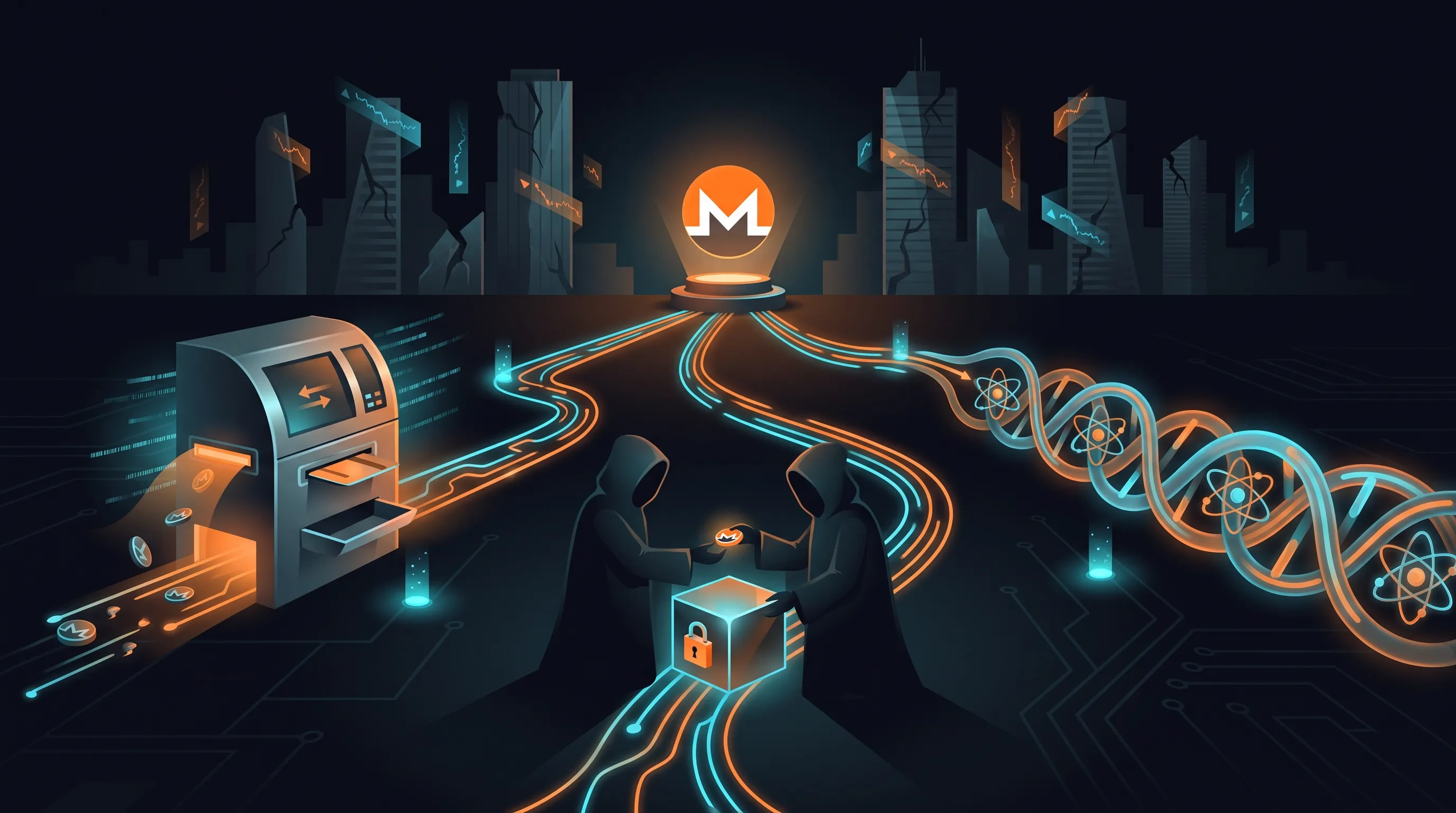
Short answer: Yes - buying Monero without KYC still works, it just no longer happens on the big exchanges. Accountless swap services convert BTC or LTC into XMR, peer-to-peer platforms like RetoSwap and Bisq trade fiat directly, and atomic swaps remove the middleman entirely.
Buying Monero privately got harder since early 2024: Binance delisted XMR on February 20, 2024, citing regulatory compliance, and a wider delisting wave through 2024-2025 pushed Monero trading off the major centralized exchanges [1]. Kraken, one of the last big venues, no longer serves EEA clients with XMR [2].
The coin did not disappear - the liquidity moved. Today the no-KYC routes are swap services, peer-to-peer markets, and atomic swaps. This guide walks through each one with the actual fees, trade-offs, and scam patterns to avoid.
One thing up front: "no KYC" is a property of the service you use, not a magic privacy cloak. How you buy, where the funds go next, and what your wallet and network leak are separate questions - the wallet guide covers the part after the purchase.
table of contents
What changed: the big exchanges mostly left
| Year | What happened |
|---|---|
| February 2024 | Binance delists XMR, citing regulatory compliance [1] |
| 2024-2025 | Delisting wave across major exchanges; Monero trading migrates to decentralized and P2P platforms [1] |
| Since then | Kraken still lists XMR, but not for EEA clients [2] |
The practical consequence: if you are in the EU, the "sign up, buy, withdraw" path at a big exchange is largely gone. What remains at centralized venues comes with KYC anyway - which defeats the point if privacy is why you want Monero.
Route 1: Instant swap services (no account)
Instant swappers are the closest replacement for the old exchange flow: you send transparent-chain crypto (usually BTC or LTC), the service sends XMR to your address, no account, no identity check. xChange.me has run this model since 2017 with an accountless interface and no KYC screening [5]; the Monero community's own directory lists several established swappers alongside it (SimpleSwap, ChangeNow, Godex, StealthEX) [2].
How the flow works:
- Pick the pair (for example BTC to XMR) and enter your own XMR wallet address as the destination - never an exchange deposit address.
- Send the input amount to the address the service shows.
- The service forwards XMR after the incoming transaction confirms. Typical total time: minutes to an hour.
Fees are built into the exchange rate rather than billed separately, so compare the effective rate against a price source before sending. Always send a small test transaction before a larger one - non-custodial means there is no support ticket that can reverse a mistake.
Note: "No KYC" does not mean "no review". xChange.me's own terms state that assets may be subject to review if a transaction is flagged as suspicious [5]. Swappers are privacy tools, not bulletproof anonymity - treat the transparent-chain input as the fingerprint it is.
Route 2: Peer-to-peer - RetoSwap and Bisq
P2P is the route with the most privacy per dollar, because you can buy directly against fiat without any crypto exchange touching the trade.
RetoSwap is the actively maintained Haveno network client: decentralized, non-custodial, runs over Tor, no KYC [3]. It supports XMR, BTC, LTC and a few other coins plus a long list of fiat payment methods - bank transfers, payment apps, cash by mail, in-person cash. Fees are explicit instead of hidden in a rate: 0.1% maker, 0.8% crypto taker, 2% fiat taker [3]. Trades are escrowed with arbitration for disputes, and no-deposit offers let first-time buyers start without already owning XMR [3].
Bisq is the long-running veteran: a desktop P2P exchange based on Bitcoin and Tor, open source, non-custodial, no KYC [2]. Its XMR trading routes through BTC, so you trade fiat for BTC to XMR - slightly more friction, backed by years of track record.
The trade-off for P2P: speed. A swap completes in minutes; a fiat P2P trade depends on bank holidays, payment rails, and the other human being online. If you need XMR tonight for a casino session, use a swapper. If you want the cleanest fiat-to-XMR pipeline, P2P is it.
Route 3: Atomic swaps - no middleman at all
Atomic swaps are the maximalist option: BTC and XMR exchange hands in a single protocol-enforced transaction with no service in the middle. Either the swap completes or both sides keep their funds - there is no custodial failure mode and no account anywhere. The Monero project announced live BTC-XMR atomic swaps in 2021 [6], and provider lists like unstoppableswap.net plus community tools (BasicSwapDEX, EigenWallet) make them usable today [2] [6].
The catch: the tooling is still enthusiast-grade. Expect command-line comfort or a niche desktop app, BTC as the input side, and liquidity that comes and goes. Atomic swaps are the right answer when the counterparty risk of swappers is unacceptable to you - not the fastest one.
Route 4: KYC exchanges that still list XMR
For completeness: a few regulated exchanges still trade XMR - Kraken (not for EEA clients), Bitfinex, DV Chain for over-the-counter sizes, and BitcoinVN for Vietnamese dong [2]. Using them means KYC, which hands an institution a permanent record connecting your identity to Monero. From a privacy standpoint that is the opposite of what this guide is about, but for larger amounts or if you simply want a regulated counterparty, they exist. Availability shifts with jurisdiction and regulation - re-check before planning around any specific venue.
Route comparison
| Route | Account | Fiat in | Speed | Cost | Best for |
|---|---|---|---|---|---|
| Instant swapper | none | no (BTC/LTC in) | minutes | fee inside rate | quick, casual amounts |
| RetoSwap / Bisq P2P | local profile | yes | hours (fiat rails) | 0.1-2% explicit fees [3] | cleanest fiat pipeline |
| Atomic swaps | none | no (BTC in) | minutes-hours | protocol + provider spread | zero counterparty risk |
| KYC exchange | full KYC | yes | fast | trading fees | convenience over privacy |
What to avoid
LocalMonero - for years the default fiat-to-XMR P2P venue - is dead. The operators wound it down in a managed process between May 7 and November 7, 2024, and the site went offline afterwards [4]. Any site or app claiming to be LocalMonero today is a clone riding the name; treat it as a scam and move on.
Three more patterns that will cost you money:
- Recovery services. Anyone who promises to "recover" lost or locked crypto for a fee is running a fraud genre with essentially no legitimate practitioners. The recovery scam is often the second hit on the same victim.
- Buying on behalf of strangers. "Send me XMR, I pay you a premium" - you are the money-mule layer of someone else's laundering, and you are the only participant with a name attached.
- Rates too good to be true. A price meaningfully better than every swapper and exchange means the discount is the bait; the exit is your deposit.
After buying: your own wallet first
Whatever route you used, the exit point is the same: move the XMR to a wallet you control before it goes anywhere near a casino. Exchange-linked deposits connect your identity to the casino; swapper-linked deposits at least tie the casino address to your swap output. A dedicated gambling wallet with one sub-address per casino severs both, and the deposit guide covers the casino-side flow from there.
Buying checklist
- Destination address is your own wallet, never an exchange deposit address
- Small test amount before any large swap or first P2P trade
- Effective rate checked against a price source before sending [5]
- P2P fiat trade: read the offer's payment method and limits before taking it [3]
- LocalMonero and anything resembling it: hard no [4]
- Nobody gets paid to "recover" crypto for you
- Funds land in your own wallet before any casino deposit
FAQ
Can I still buy Monero without KYC?
Yes. The big exchanges restricted XMR, but accountless swap services, P2P markets like RetoSwap and Bisq, and atomic swaps all still work without ID verification.
Is buying XMR without KYC legal?
That depends on where you live and the amounts involved - the coin itself is not the issue. Our legal guide explains the pieces; for binding answers check local rules.
What happened to LocalMonero?
It shut down for good. The winding-down ran from May 7 to November 7, 2024, and the site went offline after that [4]. Anything calling itself LocalMonero today is a clone and should be treated as a scam.
Are instant swap services safe?
They are non-custodial and accountless, which removes the two biggest exchange risks. But there is no support safety net and no way to reverse a bad send - use small test amounts and your own wallet as the destination.
Do I need Tor to buy XMR privately?
No. RetoSwap routes its whole network over Tor by itself [3], and swap services run fine over clearnet. Tor is optional extra hardening, not a requirement.
Ready to pick a casino? The comparison table has the live values, the finder narrows them down:
Sources
- Wikipedia - Monero (Binance delisting 2024-02-20, 2024-25 delisting wave) - accessed 2026-09-05
- getmonero.org - Merchants & Exchanges (community list, Kraken EEA note) - accessed 2026-09-05
- RetoSwap - Haveno P2P network (fees, no-KYC, fiat methods) - accessed 2026-09-05
- LocalMonero - official winding-down notice (site frozen 2024) - accessed 2026-09-05
- xChange.me - accountless instant exchange - accessed 2026-09-05
- getmonero.org - Bitcoin-Monero atomic swaps announcement - accessed 2026-09-05